
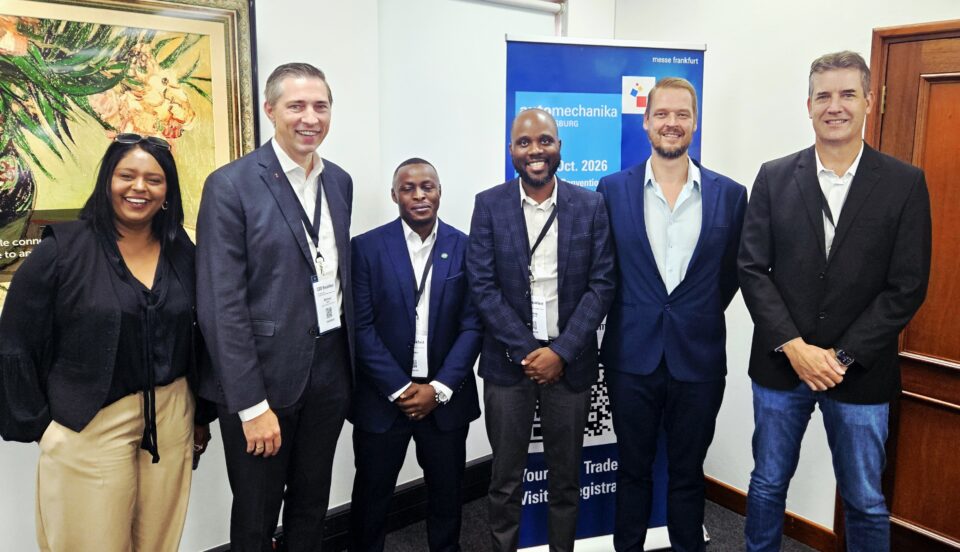
Automechanika Johannesburg convened experts from South Africa’s automotive industry at its first CEO breakfast of 2026 at the South African German Chamber of Commerce, where speakers warned that the sector’s ability to compete and grow will hinge on tackling a deepening skills crisis, while responding decisively to rapid technological disruption.
In his first official address as CEO of AHK Southern Africa, Maximilian Butek highlighted the strategic strength of the local automotive industry, stating: “South Africa’s established supplier network and deeply integrated supply chain are real competitive advantages in an increasingly crowded global market,” he said. “We must actively promote and protect this ecosystem as a differentiator.”
Skills Crisis
Ipeleng Mabusela, CEO of the Retail Motor Industry Organisation (RMI), delivered a warning on the scale of the skills challenge and its implications for economic mobility, safety and transformation. Drawing on industry data, he noted a 31% decline in artisans over a 10-year period, despite growing numbers of apprentices entering the system. “Mobility cannot be realised without addressing skills,” he implored.
Mabusela positioned the sector as a national mobility backbone, highlighting that the auto retail and aftermarket accounts for the largest share of jobs in the automotive value chain (about 70%), with aftermarket employment growing at 1.2% CAGR from 2020 to 2024.
Mabusela said scaling existing training and enterprise pipelines will require “collaboration with intent,” including partnerships spanning industry, government and training institutions.
Structural Shifts
Paul-Roux de Kock, Chief Analytics Officer of Lightstone, unpacked South Africa’s post-COVID recovery in new vehicle sales and the structural shifts reshaping the light vehicle market, including changing demand patterns, pricing dynamics and a rapid expansion in consumer choice as more brands enter the market.
“The market is getting more crowded and more complex,” he said. “Businesses need to track shifts in pricing, brand share and supply origins in order to compete effectively”.
Reshaped Industry
Greg Cress, Principal Director: Automotive & eMobility at Accenture South Africa, outlined five forces accelerating change across the global automotive industry, with direct implications for South African OEMs, suppliers and the broader mobility ecosystem.
“The global EV trend is a call-to-action for South African OEMs, who must secure NEV product lines,” he stated. Cress also pointed to the rise of advanced driver assistance systems and autonomy as a near-term localisation opportunity.
He referenced Level 4 autonomous capability (vehicles that can drive themselves without human intervention within defined operating conditions) already operating in global pilot environments.
He further noted that connectivity and software are rapidly becoming core competitive battlegrounds.
“Over-the-air (OTA) capability is becoming standard,” he pointed out, referring to vehicles that can receive remote software updates—similar to a smartphone—enabling new features, improvements and fixes without a workshop visit, adding that 75%+ of new models will have OTA update capability.
Tailored Support
Tagatso Sello, Senior Manager of Manufacturing at Nedbank, signalled the financial sector’s commitment to supporting industry-specific needs through customised financing and advisory services, emphasising that the sector’s transition requires practical, tailored solutions.
“The transformation underway in automotive demands flexible, sector-appropriate support, not one-size-fits-all approaches,” he suggested.
Deeper Collaboration
“The challenges we face today demand unprecedented collaboration,” surmised Michael Dehn, Managing Director of Messe Frankfurt South Africa. “Our 2026 engagement strategy, comprising quarterly CEO breakfasts and six regional roadshows across Southern and East Africa, creates the platforms for industry leaders to forge partnerships, share intelligence, and build resilience through greater connection,” he concluded.
