
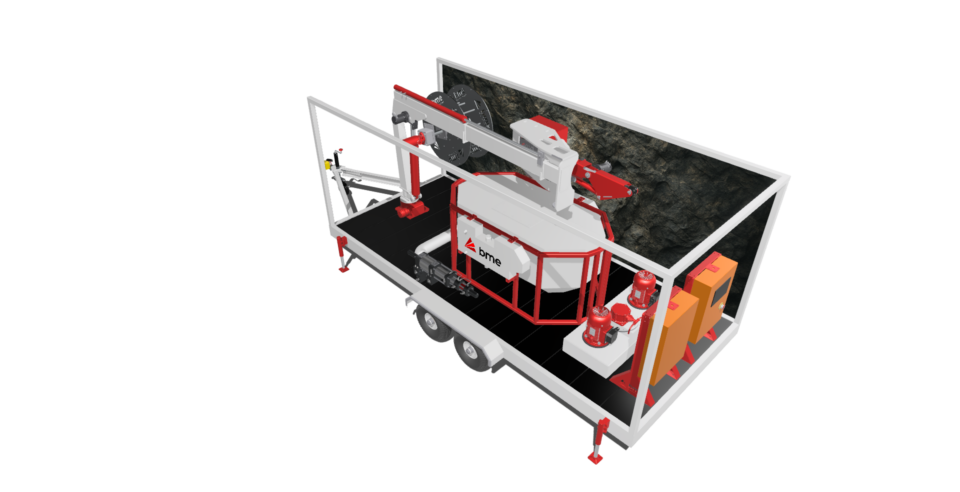
Recognising that technology alone cannot deliver safer, more productive underground mining operations, BME, an Omnia Holdings company, has developed its Portable Training Unit to bridge the gap between theoretical learning and practical application. The realistic, hands-on training platform enables mining companies to build workforce competency, improve safety, protect production assets and strengthen operational performance—without interrupting production.
According to Derrick Menezes, Regional Manager: Underground Operations at BME, workforce competency has become increasingly important as underground mining adopts more sophisticated charging equipment, automation and digital control systems.
“The industry’s ability to achieve safer blasting, greater productivity and more consistent results increasingly depend on the competency of people,” he said. “Modern underground charging technology can only deliver its full value when operators have the confidence and practical competence to use it correctly.’
Real-world training in a controlled environment
Menezes said that the full-scale physical replica of BME’s underground charging equipment reproduces the mechanical responses, operating sequences and control systems encountered during live charging operations.
“By replicating the resistance, vibration and tactile feedback of live charging equipment, the unit helps operators develop muscle memory, situational awareness and confidence before entering the demanding underground environment,” he said.
Training facilitators can also recreate equipment faults, emergency shutdowns, communication failures and common operator errors. This allows crews to identify and correct mistakes without exposing personnel, explosives or production equipment to unnecessary risk.
The Portable Training Unit is not only intended to ensure that operations teams are trained and competent for real-world conditions. It also provides engineering and maintenance teams with practical training on the equipment, helping them to develop the skills required to identify faults and carry out correct, effective and efficient repairs and servicing. This can help reduce downtime and ensure that equipment is returned to service safely and efficiently.
“Training should provide opportunities to make mistakes safely,” said Menezes. “By recreating realistic operational scenarios, operators learn how to recognise problems, respond appropriately and reinforce the correct procedures before those situations occur underground.”
Menezes added that rather than relying solely on theory, operators gain practical experience that accelerates competency development and improves decision-making under pressure. “BME’s internal observations indicate that hands-on simulation training can reduce the time required for new operators to achieve competency by between 30% and 40% compared with conventional classroom-based training,” he said.
Workforce development without downtime
Menezes noted that investing in workforce development no longer needs to come at the expense of production.
“Conventional operator training often requires active charging equipment to be removed from service, creating downtime while exposing high-value production assets to unnecessary wear and tear,” he said. “The Portable Training Unit enables production to continue uninterrupted while operators gain realistic, practical experience on equipment that accurately replicates the live operating environment.”
By shifting training away from operational equipment, mining companies reduce unnecessary wear on pumps, hoses, valves, control systems and other critical components, lowering maintenance costs while extending asset life.
Fully towable by a standard vehicle and operating on a conventional single-phase power supply, the unit can be deployed quickly to remote mining operations where access to centralised training facilities is often limited.
“This enables high-quality operator development wherever it is needed, reducing travel costs and minimising disruption to mining operations,” he said.
Standardising training across sites
Menezes said that the unit also enables mining companies to standardise training across multiple sites. “Operators are assessed against the same procedures, operational scenarios and performance benchmarks, ensuring consistency regardless of location or shift,” he noted.
Importantly, it also supports continuous learning through onboarding programmes, refresher training, spot assessments and annual re-certification, helping prevent unsafe habits from developing over time.
“Performance data – including task completion times, procedural compliance, emergency responses and error frequency – provides objective evidence of competency while supporting workforce planning, compliance reporting and continuous improvement,” he said.
Preparing today’s workforce for tomorrow’s technology
Menezes said the Portable Training Unit has also been designed to prepare operators for the next generation of underground charging technologies. “Compatibility with BME’s Cross Control platform familiarises crews with the digital interfaces and control logic that will underpin future equipment, reducing the learning curve as new technologies are introduced,” he states.
He adds that the Portable Training Unit reflects BME’s broader commitment to developing people with the same focus and innovation it applies to developing equipment.
“As underground mining continues to evolve, BME believes sustainable operational improvement will come not only from smarter equipment, but from continued investment in the people who use it. The Portable Training Unit is one example of how the company is helping customers achieve both,” he concludes.
Ends.
