
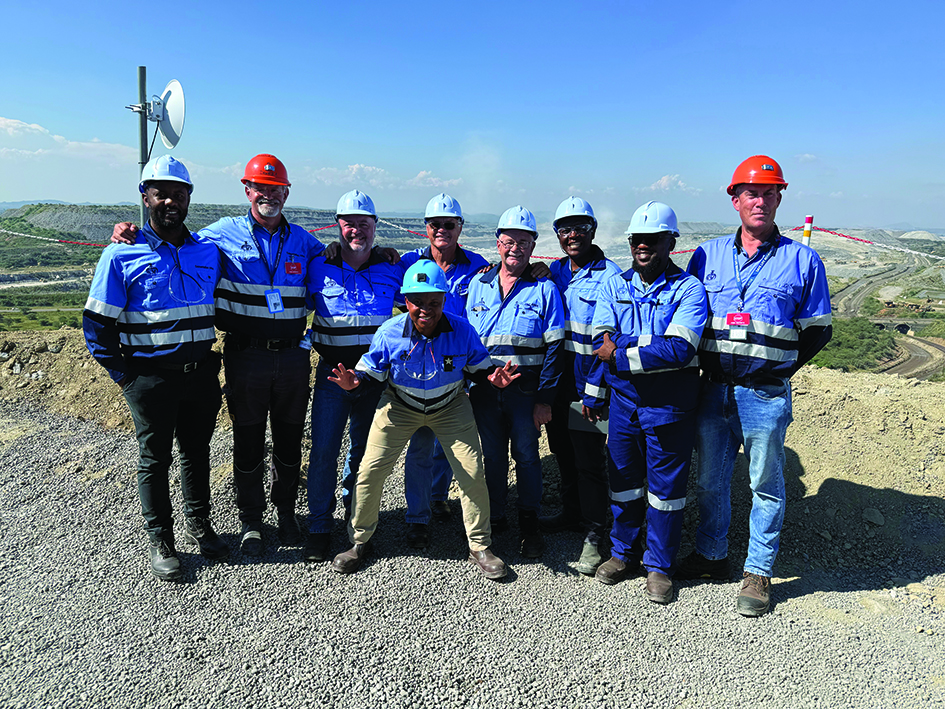
Tharisa Minerals has officially commenced the next phase of its mining journey with the inaugural blast at its underground project on Tuesday, 31 March 2026, marking the start of a significant transition from open pit to underground mining at its world-class chrome and platinum group metals (PGM) operation in South Africa’s Bushveld Complex.
The milestone signals the beginning of a strategic underground development programme that will extend the life of the mine well beyond the expected depletion of open pit resources in 2034. The new bord and pillar operation on the tabular reef is designed to sustain production at 5,6 Mtpa (with headroom to 6,2 Mtpa) and secure the long-term future of one of the country’s key mining assets.
Cementation Africa has been appointed as the key development partner for the underground project and will, over the next 5 years, be responsible for the early works, the main development programme as well as the production ramp-up to circa 255 kt per month.
Commenting on the milestone, Japie du Plessis, Managing Director of Cementation Africa, says the inaugural blast represents a significant moment for both the client and the broader mining sector.
“The inaugural blast marks the start of an important new era for Tharisa and is a major milestone in extending the life of this world-class mining operation,” du Plessis says. “We are proud to have been selected as the development partner for this project and to play a leading role in supporting Tharisa’s transition to underground mining.”
He explains that the appointment follows a period of technical and commercial engagement between the two companies.
“This is a strategically important project for the South African mining sector,” he says. “The collaboration with Tharisa to date has been highly professional and forward-looking, which is essential for a project of this scale and complexity.”
The early works phase at the Apollo portal complex includes the development of three portals with a total advance of approximately 140 metres. These works include critical ground support measures, arch-set installations and shotcrete application to ensure long-term stability and safe access to the underground workings.
Following the completion of this phase, the project will move into a five-year main development and stoping contract, paving the way towards steady-state underground production.
Du Plessis notes that Cementation Africa’s role extends beyond mine development and excavation to include the establishment of the systems, governance structures and safety frameworks required for underground operations.
“Successful underground mining depends on much more than physical development,” he says. “It requires robust governance, comprehensive safety systems and the right operational procedures to support long-term production.”
As one of the continent’s leading underground mining contractors, Cementation Africa brings extensive experience in underground mine development, raiseboring and shaft sinking, and has been instrumental in transitioning a number of large open pit mines to underground operations.
“Our ability to take mines from early development through to steady-state production is a key strength,” du Plessis says. “This institutional knowledge, combined with our technical capability and training infrastructure, is a major value-add for clients undertaking complex transitions such as this.”
The project also includes significant skills development and workforce mobilisation. Through its Training Academy near Carletonville, Cementation Africa will support the reskilling of personnel as the operation transitions from an open pit environment to mechanised underground mining.
The underground mine geometry is well suited to mechanised bord and pillar mining methods, supported by a fit-for-purpose fleet of trackless mining machinery including load haul dumpers, underground trucks, drill rigs, bolters, scissor lifts, shotcrete machines and graders.
Du Plessis adds that innovation and collaboration with OEM partners will also form part of the project’s long-term success, including the adaptation of proven technologies to improve ore handling and operational efficiency.
“This project reflects the future of mining in South Africa, where innovation, technical excellence and strong partnerships are essential to unlocking long-term value,” he concludes.
