


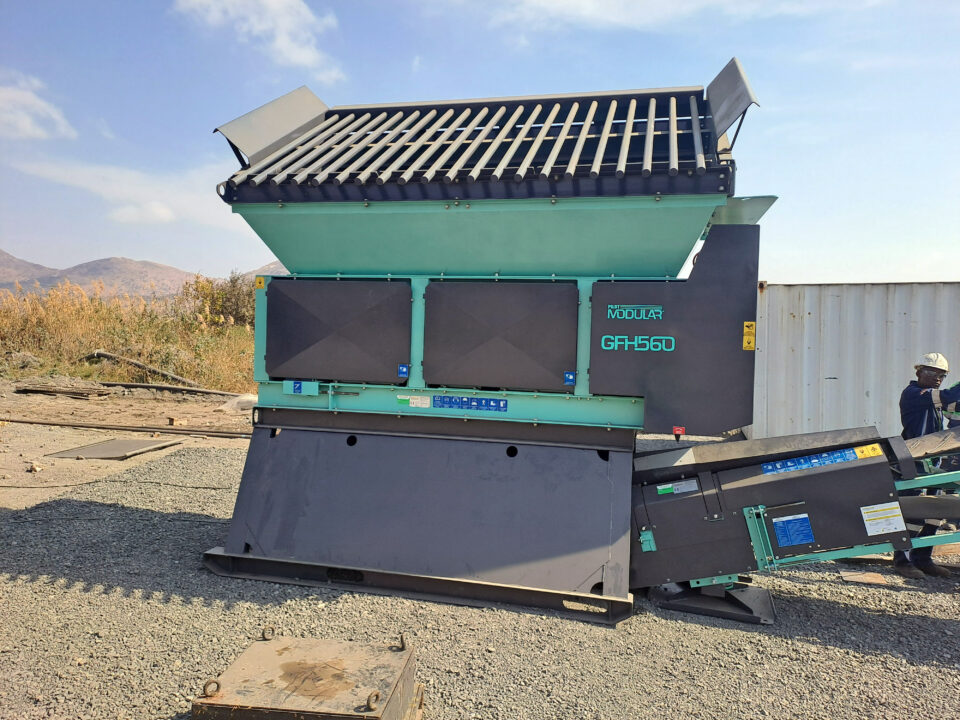
A recent increase in sales of Pilot Crushtec’s BFH1000 belt feed hopper and GFH560 grizzly feed hopper is highlighting a broader shift in what customers expect from materials handling equipment.
According to Wayne Warren, Africa Sales Manager at Pilot Crushtec, the recent sales growth shows that the market is favouring proven designs that are readily available and solutions that are adaptable to specific applications.
“Customers are realising that, when correctly specified for their duty, the right feed hoppers are capable of improving the performance of the entire processing plant,” Warren says. “This is what Pilot Crushtec’s established modular feeder range can offer and growing demand shows that it is what the market values.”
In addition to being available off-the-shelf in a range of well-established designs, the company’s feed hoppers are known for the flexibility of its base units. The BFH1000 and GFH560 illustrate this flexibility particularly well, he argues.
“Both these units are designed to provide surge capacity and a controlled feed into downstream equipment, but the GFH560 incorporates a heavy-duty tipping grizzly to scalp oversize material before it reaches the crusher,” he explains. “Its specification allows throughput of 30-200 tonnes per hour, with feed sizes up to 150 mm depending on material – while the BFH1000 offers up to 500 tonnes per hour and can accommodate feed material up to 300 mm.”
The BFH1000 provides a particularly substantial surge capacity, with a 14 m³ heaped hopper, variable-speed belt and 15 kW drive. Its hopper extension can increase capacity to almost 20 m³. The GFH560 has a 3.6 m³ hopper, with an optional extension increasing this to around 6 m³, while its 650 mm variable-speed belt can regulate material flow to suit the plant.
Warren highlights that the sales trend also reinforces the importance of selecting a feeder according to the complete application, rather than simply the crusher being fed.
“Other important factors to consider are the feed size, feed volume, storage volume, abrasiveness of material, and moisture content,” he says.
Consistent feed is also critical in the full utilisation of downstream equipment. A hopper absorbs fluctuations in loading and creates a steady material flow, Warren emphasises, allowing crushers and screens to operate closer to their optimal conditions.
“This can improve production consistency, maximise available power and promote more even wear,” he says.
The GFH560 adds another benefit by removing +100 mm oversize material before the crushing stage, while also providing surge capacity and steady feed output.
Pilot Crushtec’s modular philosophy is a further source of value for customers, Warren says. Skid-mounted units can be installed on a level, compact surface without extensive civil work, while their standardised design allows equipment to be relocated or adapted as production requirements change. The units are designed for quick setup and integration within the Pilot Modular system.
“This adaptability is increasingly relevant to customers looking to add capacity, or to process previously uneconomic material,” he says. “It also helps when they want to modify an existing plant but need to be conservative with their capital outlay.”
A recent Zambian application illustrates the point, where a Pilot Modular cone crusher was relocated to a different section of the operation and subsequently paired with a GFH560 for a new application.
