
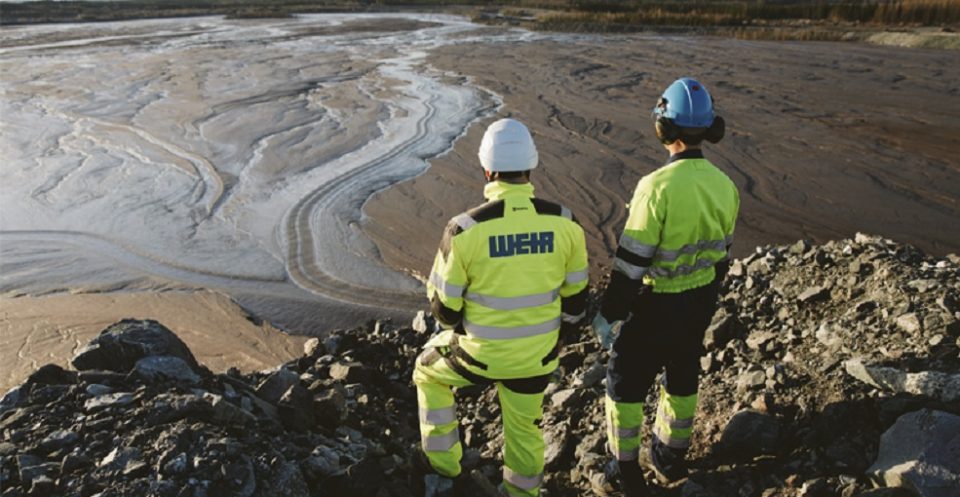
With increased scrutiny and pressure to improve the management of tailings, it is important to look at different methods to improve this process. A critical component of a responsible management strategy is dewatering.
Mike Swintak, regional senior product manager for Weir Minerals, says: “Dewatering tailings can be a difficult process, however when undertaken successfully, it can deliver significant benefits to mine operators.”
The most important benefit of dewatering tailings is the reduction of water that needs to be transported from a process plant to a tailings storage facility (TSF). Reduced water content means tailings’ slurry volume is decreased, allowing for smaller pipelines and pumping equipment to be used, which can minimise power requirements.
Thickened tailings and paste can improve the stability of TSFs and reduce their footprint. In some instances where existing TSF capacities are limited by regulatory or other environmental considerations, thickened tailings can help to extend the life of the mine. Proper containment of tailings reduces the risk to people and the environment and when decommissioning a mine, thickened tailings facilities are easier to rehabilitate.
Increasingly, thickened tailings are also used for underground mine backfill. This can increase productivity and reduce mine cycle times as well as surface TSF disposal volumes. Underground mining conditions can also be improved due to decreased water and slimes’ handling.
Challenges “When tailings are not properly managed, the results can be lethal. It is vital that mine operators have a clear underlying of key risks and considerations related to this process, in particular, tailings’ dewatering”, states Mike Swintak.
Every mine site is different and subject to varying environmental, regulatory, capital and operating cost constraints. Cost is a key consideration for many operators and can adversely affect the viability of a mine site. Therefore, it is necessary to implement a tailings management strategy which provides both reliability and value for money.
Environmental limitations are also a major factor when establishing a TSF. In parts of the world where there is challenging topography, such as mountainous regions or other environmentally sensitive landscapes, TSFs may need to be built further away from the process plant. This can result in slurry being transported across longer distances or at higher elevations. Dewatering of tailings is a viable option in these scenarios as less slurry needs to be moved, in turn reducing operational costs.
Some operations produce highly diluted tailings which require extensive dewatering to reach the desired level of thickness. Other slurries may contain extremely fine particle solids, which can also be difficult to manage. Large mine sites or those with complex ore bodies can produce many types of tailings waste slurries, which may require varying methods of treatment.
Across this multitude of situations, the operator must determine all associated costs and assess the level of dewatering required to confirm the most suitable solution for their site. While some mines are in a position to increase the size of their TSFs, many are not and must implement a viable dewatering process, which can involve significant capital expenditure.
If dewatering tailings to the highest possible degree, operators also need to develop a suitable strategy for transporting the waste material. Tailings which are too thick to be pumped may need to be transported by either a conveyor system or truck.
Finally, when a mine site reaches the end of its life and moves into the decommissioning phase, TSFs must be dealt with in accordance with regulatory and legislative requirements. As many mine sites need to be rehabilitated and restored to a natural state, a key benefit of producing thickened tailings is its ability to be covered with overburden and re-planted with suitable vegetation.
Tailings management Weir Minerals knows that dewatering tailings can be a daunting process for many operators. In order to provide the highest level of support and service, the company has invested heavily in its tailings’ management capabilities. Every mine site is assessed on a case by case basis to provide a complete tailings dewatering system customised to the customer’s applications and constraints.
Mike Swintak says that Weir Minerals’ tailings solutions include many different elements, such as developing flow sheets and process requirements to supplying equipment. The company’s extensive product portfolio includes Isodry® thickeners and filters, Multiflo® floating and mobile pump systems for use on tailings ponds and GEHO® positive displacement pumps capable of transporting high density slurries up to 550 km.
Weir Minerals has an intensive pilot plant, the Weir Technical Centre in Australia. This facility is designed to test tailings samples from around the world to help ascertain the best way to process them in line with the customer’s requirements. Testing is conducted using thickeners/clarifiers, hydrocyclones, filters and centrifuges as well as a comprehensive pipe loop facility for determining high density slurry pipeline design.
Weir Minerals can also conduct testing at customer mine sites to assess the viability of various tailings management strategies. The company says it has the equipment, engineering capabilities and process knowledge to fully support customers in their tailings dewatering applications, allowing them to produce waste material which is easier to store and transport.
As the mining industry gains a better understanding of tailings, it is vital that new and improved methods of containment and storage are developed. Weir Minerals believes that the dewatering of tailings has a fundamental role to play in this and continues to push the boundaries of possibility. The company is developing a new tailings dewatering solution, which allows operators to pump slurry containing an extremely high percentage of solids. The company plans to launch this new technology in 2020.
