
In manufacturing, honing rarely commands the same attention as milling, turning, grinding, or robotics. Yet in many precision applications, it may be one of the most consequential processes in the production chain, affecting part performance, throughput, quality, and cost in ways that are often disproportionate to its relatively narrow place in the machine tool world.
Honing also carries unusual operational weight because it often occurs late in the manufacturing process, after significant value has already been added through material, machining, labor, and scheduling. By that point, inefficiencies are amplified, and mistakes become expensive, making honing far more than a finishing operation.
That reality changes how honing should be viewed. Rather than a straightforward machine purchase, it is better understood as a precision-critical process that deserves strategic planning from the outset, because the decisions made before honing begins often determine how efficiently and consistently it will perform.
Why Honing Is Different
A finishing process with outsized consequences
Unlike drilling or boring, which establish and enlarge a hole, honing is designed to perfect it. The objective is not simply material removal, but the correction and refinement of bore geometry, dimensional accuracy, and surface finish—qualities that directly affect how a part performs in real-world use.
The process uses abrasive stones mounted on an expanding mandrel that rotates and reciprocates inside the bore, or, in single-pass applications, a galvanic diamond-coated single-stroke tool that achieves the finished bore in a single pass. This combined motion removes small amounts of material while improving roundness, straightness, cylindricity, and surface characteristics. In many applications, honing achieves levels of precision and surface control, with a speed that other machining processes cannot match economically.
That precision directly affects downstream performance. In hydraulic cylinders, it affects sealing and leakage. In engine cylinders, it affects lubrication retention and wear. In aerospace and medical applications, it can directly affect reliability, friction, and service life, making the bore a functional performance surface rather than just a machined dimension.
Because honing often occurs late in the manufacturing cycle, those functional gains, or failures, carry disproportionate operational consequences. That makes honing uniquely sensitive to decisions made earlier in production, including stock allowance, tooling strategy, and machine selection.
Why Strategic Honing Decisions Create Value
Strategic honing decisions create value in several ways: improving labor efficiency, increasing throughput, strengthening process consistency, and supporting future production growth. When these factors are considered together, not just machine price, the financial impact can be significant. Well-designed honing solutions typically achieve payback within three years; when the application volume is substantial, payback within one to two years is not uncommon.
Labor efficiency
Traditional honing depended heavily on operator experience. Skilled operators understood abrasive behavior, stock-removal patterns, tooling wear, and the subtle adjustments needed to maintain bore geometry throughout the cycle. That expertise remains important, but modern honing systems increasingly embed much of that process knowledge directly into the machine.
Advanced systems now use automatic geometry correction, load sensing, tool overload protection, and stone wear compensation to monitor and adjust the process in real time. Instead of relying on repeated operator intervention, the machine actively manages critical process variables while the cycle continues.
That changes labor economics significantly. When the machine handles more of the process itself, the operator spends less time monitoring the cycle and more time preparing setups, inspecting parts, or supporting adjacent operations. In many production environments, this allows one operator to support multiple machines or stages of production.
The result is not just labor savings, but better labor utilization. In a manufacturing environment where experienced operators are increasingly difficult to find and retain, reducing dependency on specialized manual intervention can be a major operational advantage.
Throughput and productivity
Automation improves throughput for the same reason it improves labor efficiency: it reduces interruptions.
Automatic geometry correction is one of the most important advances in modern honing because it addresses one of the process’s traditional inefficiencies—manual correction during the cycle. As the machine senses load changes and bore conditions, it can make real-time corrections for taper, waviness, while maintaining process continuity. (Roundness correction is achieved by the tool geometry itself rather than by the auto-correction software.)
That improves cycle efficiency in practical ways. Fewer interruptions shorten cycle times, improve machine utilization, and increase output per shift. In high-volume environments, even small reductions in cycle time can create significant throughput gains over the life of the machine.
Those gains compound.
And over time, they become measurable.
Consistency and quality
In honing, consistency affects far more than final quality. It affects throughput, scheduling, job quoting, and process stability because every manual adjustment introduces variability, and variability creates hidden costs through scrap, rework, inconsistent cycle times, and production delays.
Modern process controls reduce that variability by continuously monitoring tool load, managing stone expansion, and compensating for abrasive wear. These actions create more stable process conditions from part to part and shift to shift, improving both bore quality and operational reliability.
This stability improves more than the finished part. It improves confidence in production planning because cycle times become more predictable, process capability becomes more stable, and delivery schedules become easier to maintain.
Predictability has value.
Capacity and scalability
Strategic honing decisions also affect long-term production capacity. A machine selected only for current demand may become tomorrow’s bottleneck, forcing additional shifts, more operators, or earlier capital reinvestment. Those downstream costs often exceed the apparent savings of selecting a smaller machine at the outset.
A more capable machine may require a larger initial investment, but if it absorbs growth, shortens cycle times, or reduces labor dependency, it often creates stronger operational value over its working life. That is one of the most overlooked aspects of strategic machine selection.
Capacity planning is not just about today. It is about ensuring that the process can scale efficiently as business needs change, without creating operational friction or avoidable cost expansion.
Modern Honing Machines Are Smarter
Automation has evolved into process intelligence
The operational gains of strategic honing decisions are increasingly driven by advances in machine technology. Modern honing systems do far more than automate motion. They actively manage the process itself, embedding process intelligence into the machine and reducing the need for constant operator intervention.
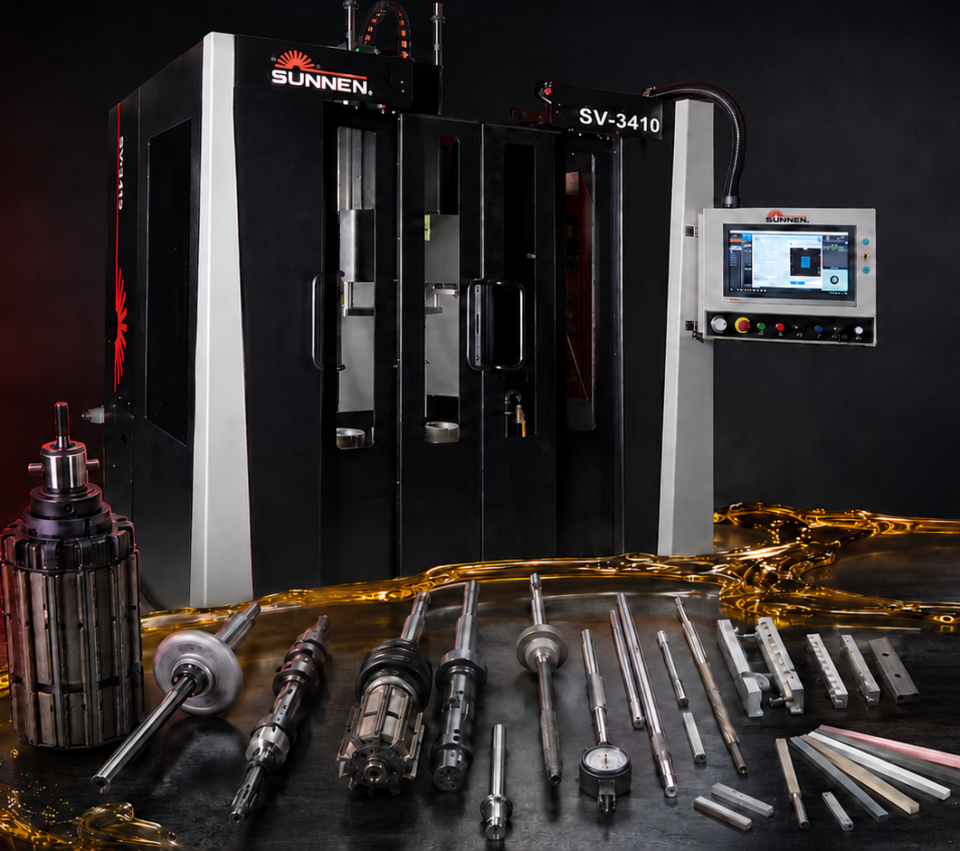
Sunnen has been a leader in that evolution, helping move honing from a largely operator-dependent process to one driven by real-time sensing, adaptive controls, and integrated process intelligence. That shift has improved both the economics and consistency of honing.
Advanced systems now combine automatic geometry correction, integrated gaging, load sensing, and stone wear compensation to monitor bore conditions and make real-time adjustments during the cycle. Instead of stopping to inspect and manually correct, the machine can respond dynamically while cutting, maintaining process continuity and improving repeatability. (sunnen.com)
Closing the loop
One of the most important advances is the integration of in-process gaging and automatic correction. Modern systems can measure bore size and geometry during the honing cycle and automatically adjust, or stop, when specifications are reached.
That creates a closed-loop process, where measurement and correction happen as part of the same cycle rather than as separate manual steps. The result is tighter process control, shorter cycle times, reduced operator dependency, and greater consistency across longer production runs.
Modern systems can also store job programs, tooling parameters, and machine settings for repeat jobs, reducing setup time and making expertise more repeatable across operators and production runs. That may be one of the most important advances in honing today: the machine is no longer just running the process, but actively helping manage it.
What a Strategic Honing Approach Looks Like
Solution design before machine selection
One of the strongest advantages of working with a specialized honing partner begins before the machine is ever selected. At that stage, the goal is not simply to match a machine to a bore size or tolerance or production volume. It is to define the best process solution based on the facility’s production reality.
That means understanding annual volume, labor structure, upstream machining conditions, growth expectations, stock allowance, cycle-time targets, and long-term business requirements. Those variables often reshape the machine decision because the machine a customer initially asks for is not always the machine that creates the best long-term operational result.
A technically capable machine may still be the wrong operational choice if it creates unnecessary labor dependency, reaches capacity too quickly, or lacks automation features that improve consistency and throughput. That is where deep application expertise matters, not simply in honing, but in the customer’s application and business realities.
Designing the full process
A strategic honing solution includes far more than the machine itself. Tooling affects contact stability and expansion behavior. Abrasives affect stock-removal rates and finish quality. Fluids affect lubrication, cooling, and swarf evacuation. Gaging affects process verification and feedback.
These are not secondary considerations; they are core process variables. Changing one often affects the others, which is why process design works best when these elements are considered together rather than selected separately.
When the machine and the supporting process elements are engineered together, compatibility improves and process stabilization happens faster. That shortens development time, reduces trial-and-error, and improves the path to predictable production.
Looking upstream
Some of the most important honing decisions happen before the part ever reaches the honing machine. A common inefficiency occurs when earlier machining operations leave excessive stock as a safety margin, assuming the honing process can simply remove the extra material later.
That often creates downstream inefficiency.
Too much stock entering the honing process increases cycle time, accelerates abrasive wear, increases machine occupancy, and raises labor cost. What appears to reduce risk upstream often expands cost downstream by making the finishing process work harder than necessary.
Honing is highly effective at precision correction and final surface refinement, but it is not the most efficient bulk stock-removal process. When upstream drilling and boring operations are optimized correctly, honing becomes faster, more consistent, and more economical because it can focus on what it does best.
That improves the entire process.
Why guarantees are possible
A supplier that understands the full honing process, not just the machine, but the tooling, abrasives, fluids, incoming bore condition, and production requirements can define expected outcomes with far greater confidence. That includes cycle time, process capability, tool life, and cost per part.
That level of predictability is difficult to achieve when the process is assembled from disconnected suppliers or developed without deep application knowledge. Honing performance depends on how all of these variables interact, which is why an integrated process model creates a significant advantage.
Just as important, that process knowledge must be combined with a clear understanding of the customer’s broader manufacturing reality, including upstream machining operations, stock allowance, labor constraints, production flow, throughput requirements, and long-term growth plans. The best solution is not simply the one that produces the part, but the one that supports the entire manufacturing process as efficiently as possible.
At Sunnen, we take that strategic, integrated approach by working closely with customers to understand not only the bore and the honing requirements, but also the upstream machining process, production challenges, and long-term operational goals before recommending a solution. Critically, that process includes working with the customer to define the expected ROI and to confirm that the right machine is selected for their specific production reality, not simply the machine they initially asked for. To make that ROI concrete, Sunnen uses a structured cost calculation that factors in annual production volume, operator costs, shift structure, and growth potential, turning what can feel like a subjective investment decision into a quantified business case. That allows us to design not just the right machine, but the right process, matching machine capability, automation features, tooling, abrasives, and fluids to the application as a complete system.
That combination of process expertise, upstream process understanding, and application knowledge enables Sunnen to offer something that is still uncommon in machine-tool purchasing: a guarantee of honing time and cost per part. That is not a catalog promise. It is a commitment built on deep application knowledge, confirmed through a thorough understanding of the customer’s specific process, before the machine is ever ordered. Most competitors do not offer this, because making that guarantee requires a level of process confidence that only comes from experience, integration, and genuine investment in the customer’s outcome.
Continuous refinement after installation
The process does not stop evolving once production begins. Tooling may be refined, abrasives adjusted, process parameters tightened, and upstream bore conditions improved. These refinements are often incremental, but over time they improve throughput, consistency, and tool life.
Because the supplier remains involved through tooling, abrasives, fluids, and technical process support, the relationship continues to create operational value long after the machine is installed. That continuity matters because honing is not a one-time equipment decision; it is an ongoing production process that benefits from continuous refinement.
That long-term value depends not just on products, but on people. Sunnen’s global network spans more than 30 countries, with technical specialists positioned to support customers locally and, critically, in their own language. In honing, a process where operators develop real expertise over time, having access to local technical support that can communicate directly with the production team is a meaningful operational advantage that catalog suppliers and low-cost competitors rarely match.
The Real Return of Strategic Honing
The value of honing lies not just in the machine, but in the process behind it—how it is designed, integrated, and refined over time. That process begins before machine selection, with a clear understanding of production needs, upstream conditions, and long-term goals.
Modern automation has accelerated those gains through automatic correction, load sensing, wear compensation, and integrated process control. But those technologies create the most value when they are part of a larger process strategy.
That is the real return of strategic honing: better precision, greater predictability, and stronger manufacturing performance.
